
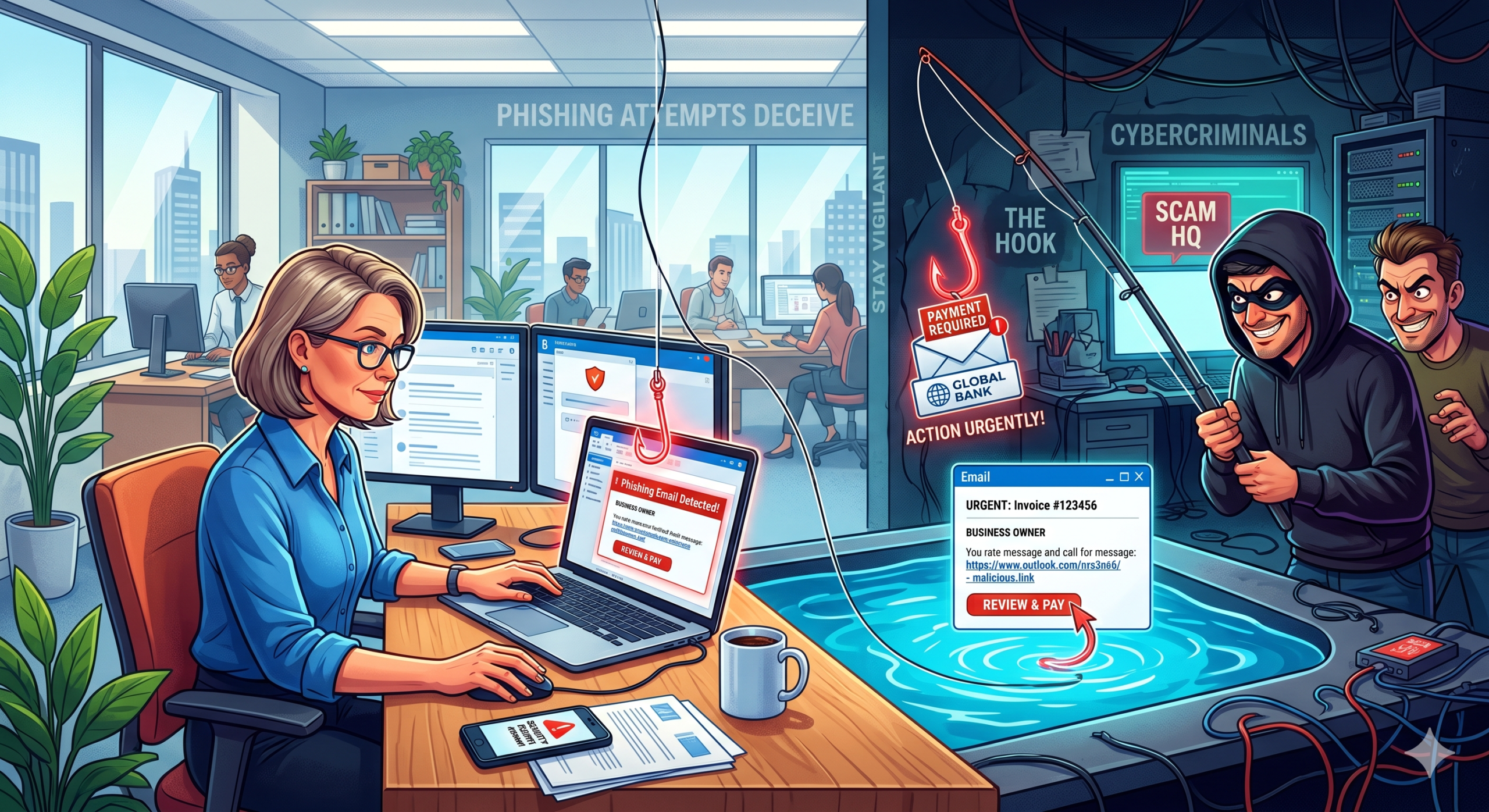
Imagine receiving an email from your bank asking you to verify your account details urgently, or a message from what looks like your software provider telling you that your subscription is about to be suspended. You click the link, enter your credentials, and move on with your day, except that email was never from your bank, and the link you just clicked handed your login information directly to a cybercriminal.
That is called phishing, and it is one of the most common, most damaging, and most preventable forms of cybercrime affecting small businesses today.
This cybercrime is so common that it’d be unwise for any serious business owner not to take precautions. The good news is that with the right knowledge and the right systems in place, your business does not have to be a victim. so, before we get right into HOW to prevent this cybercrime, let’s understand WHAT it means.
What Is a Phishing Attack?
Phishing is a type of cyberattack where a criminal impersonates a trusted person, company, or institution, through email, text message, or phone call in order to trick you into giving up sensitive information. That information might be your login credentials, financial details, or access to your business systems.
The name “phishing” is no accident. Just like a fisherman casts a line with bait hoping something will bite, cybercriminals cast out convincing messages hoping someone will take the hook. And unfortunately, people do, every single day.
Think of it this way: if a stranger puts on a uniform, walked up to your front door, and told you there was an emergency that required you to hand over your house keys right now, you would most likely hesitate and ask questions. However, if you get a call and you hear the voice of your business accountant asking you to send some important account details to authorize a transaction, you most likely will fall for it. And this is because, it is always easier to fall for scams online before realizing what has happened.
Why Phishing Works So Well
Phishing attacks are effective because they do not target your systems, they target your people. No firewall can stop an employee from clicking a link in good faith. No antivirus software can prevent a person from entering their password into what looks like a completely legitimate login page.
Cybercriminals are also getting significantly more sophisticated. As we covered in our earlier blog post on Artificial Intelligence, AI tools are now being used to craft phishing emails that are grammatically perfect, highly personalized, and designed to look exactly like communication from companies your business already trusts. The days of poorly worded emails with obvious red flags are behind us. Today’s phishing attempts are polished, targeted, and alarmingly convincing, which means you also need to improve your skills of identifying them.
The Different Types of Phishing Attacks
You know how there are different ways to catch a fish (through hooks, net, hand etc.), there are also different types of phishing attacks. Here are the most common forms your business is likely to encounter:
1. Email Phishing: This is the most common type. A fraudulent email is sent to a large number of people, impersonating a well-known brand like Microsoft, your bank, a courier company, or even a government agency. The email typically contains a link to a fake website designed to steal your credentials, or an attachment that installs malware on your device the moment it is opened.
2. Spear Phishing: Unlike broad email phishing, spear phishing is highly targeted. The attacker researches a specific individual or business, using publicly available information from websites, LinkedIn, or social media, and crafts a message that is personalized and relevant. It might appear to come from a colleague, a client, or a supplier. Because it feels familiar, it is significantly harder to detect.
3. Whaling: Whaling is spear phishing aimed specifically at senior executives or business owners, that is, the “big fish.” These attacks often impersonate legal firms, financial institutions, or board-level contacts, and typically involve requests for large wire transfers or confidential business information.
4. Smishing and Vishing: Smishing is phishing conducted via SMS text message. Vishing is the voice-call version, where a criminal calls you directly, often impersonating a bank, IT support team, or government official. With AI-powered voice cloning now a reality, vishing attacks are becoming harder to identify even when you think you know the voice on the other end.
5. Clone Phishing: In this method, a legitimate email that was previously sent to you is duplicated and slightly altered, usually with a malicious link replacing a legitimate one. Because it looks like a familiar conversation, the recipient is far less likely to question it.
The Real Cost of a Phishing Attack
A successful phishing attack can cause serious and lasting damage to a small business. Beyond the immediate loss of data or money, the consequences can include:
- Financial loss from fraudulent wire transfers or unauthorized account access
- Data breaches that expose your clients’ personal and financial information
- Ransomware installation that locks you out of your own systems until a payment is made
- Reputational damage that erodes the trust your clients have placed in you
- Legal and compliance consequences if client data is exposed due to inadequate security
For small businesses that may not have the resources to absorb a major incident, a single successful phishing attack can be genuinely devastating.
How to Protect Your Business from Phishing
The encouraging thing about phishing is that it is very preventable, when you know what to look for and have the right protections in place.
1. Train Your Team: Your employees are your first and most important line of defense. Regular security awareness training helps your team recognize the signs of a phishing attempt such as suspicious sender addresses, unexpected urgency, unusual requests, and links that do not match the company they claim to represent. When your employees know what to look for, they are far less likely to take the bait.
2. Enable Multi-Factor Authentication (MFA): Even if a phishing attack succeeds in stealing a password, MFA means that stolen credential alone is not enough to gain access. As we covered in our earlier post on MFA, adding that second layer of verification is one of the single most effective steps a business can take to limit the damage of a compromised account.
3. Use Advanced Email Security Tools: Modern email security solutions go far beyond basic spam filters. AI-powered tools can analyze incoming emails for signs of phishing: suspicious links, impersonation patterns, spoofed domains and quarantine them before they ever reach your team’s inbox.
4. Verify Unusual Requests: Establish a culture in your business where any unusual request, particularly those involving money, passwords, or access to systemsa is verified through a secondary channel before any action is taken. If you receive an email from your bank asking you to click a link urgently, call your bank directly on a known number rather than responding to the email.
5. Keep Software and Systems Updated: Many phishing attacks rely on delivering malware through links or attachments that exploit vulnerabilities in outdated software. Keeping all systems, browsers, and applications up to date closes those gaps before they can be used against you.
6. Partner with an IT Provider Who Stays Ahead of Threats: Phishing tactics evolve constantly. What worked as a detection method six months ago may not catch today’s attacks. Having a managed IT partner who is actively monitoring, updating, and adapting your security posture means you are not trying to fight today’s threats with yesterday’s defenses.
The Human Side of Phishing
Here’s something I thought to add: falling for a phishing attack does not mean you are careless or unintelligent. These attacks are designed by professionals whose entire job is to make them convincing. They exploit trust, urgency, and familiarity, and they are getting better at it every year. So, incase you’ve ever falling for a phishing attack, cut yourself some slack and learn how not to fall again.
The goal is not to make your team feel suspicious of every email they receive, instead it is to build awareness, create smart habits, and put systems in place that make it significantly harder for an attacker to succeed, even on a bad day.
At StonePoint Technology Partners, we help small and mid-sized businesses build that kind of layered, human-aware security. Because protecting your business also involves making sure the people inside your business are equipped to recognize and respond to the very real threats that land in their inbox every day.
Cybersecurity does not have to be complicated, but it does need to be intentional. If you are concerned about whether your business is adequately protected against phishing and other cyber threats, we would love to talk.
Send us an email at Info@stonepointtech.com or call us at (727) 478-7355. We are here to help.