
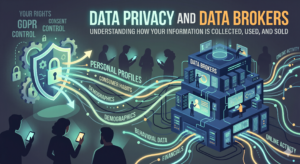
Imagine a trusted friend sharing your private information with people you never intended to know. In many ways, that is what is happening every day with personal and business data; information about you, your company, and even your clients is being collected, packaged, bought, and sold, often without your knowledge or consent.
This is the world of data brokers: companies whose business model depends on gathering information from a wide range of sources and distributing it to advertisers, marketers, and other third parties. These organizations operate legally and often out of plain sight, which makes them especially important for businesses to understand.
In today’s digital economy, data privacy is no longer just a technical issue, it is a business responsibility. Protecting sensitive information helps safeguard trust, reduce risk, and ensure that both your business and your clients are not exposed to unnecessary privacy threats. To understand why this matters, it is important to first define what data privacy really means.
What Is Data Privacy?
Data privacy refers to the right of individuals and businesses to control how personal and sensitive information is collected, used, shared, and stored. This includes everyday details such as names, addresses, and phone numbers, as well as more sensitive information like financial records, browsing activity, purchase history, and location data.
For businesses, data privacy is not only about protecting internal information. If your organization collects data from clients, you are responsible for handling that data with care, transparency, and strong security measures. Failing to do so can damage trust and reputation, and in many cases, it can also create legal risk.
A simple way to think about it is this: when a client gives you access to something valuable, they expect you to use it for its intended purpose and protect it from misuse. Data should be treated with the same level of responsibility.
What Are Data Brokers?
Data brokers are companies that collect large volumes of information about individuals and businesses and then sell that information to third parties. They gather data from a wide range of sources, including public records, social media profiles, loyalty programs, website activity, purchase histories, and other digital traces, then organize it into detailed personal and business profiles.
These profiles can include:
- Full names and addresses
- Phone numbers and email addresses
- Employment history and income estimates
- Shopping behavior and brand preferences
- Family relationships and household details
- Political affiliations and interests
The data is then sold to buyers such as marketers, insurers, employers, and landlords. and, in some cases, bad actors who use it for targeted scams, phishing attacks, and identity theft.
And here is what makes this particularly alarming for businesses: it is not just individual employees whose data is at risk. Business owners, executives, and key staff members can all have detailed profiles built on them, profiles that can be used to craft convincing social engineering attacks against your company.
Why This Matters for Your Business
You may be asking: if data brokers operate legally, why should I be worried? The answer is that the risk is not limited to what these companies do with data internally. The real danger begins when that information is exposed, misused, or placed in the hands of criminals or other bad actors.
When cyber criminals already know your name, company, role, vendors, and team structure, phishing attempts become far more convincing. A generic scam email is easy to dismiss, but a message that is personalized and appears to come from a trusted source can be much harder to detect.
Business identity theft is also on the rise. Criminals can use purchased or publicly available data to impersonate companies, open fraudulent accounts, or redirect payments. In addition, weak data privacy practices can lead to client data breaches, especially when sensitive information is stored insecurely or shared with third-party tools without proper review.
For businesses, data privacy is therefore not just a compliance issue. It is a critical part of protecting security, reputation, and client trust.
What Can You Do About It?
The good news is that data privacy is not something you need to solve all at once. It begins with awareness and improves through small, intentional steps. The following points below are ways you can go about protecting your data and that of your clients.
- Know What Data You Collect: Before you can protect data, you need to know exactly what you have. Review the information your business collects from clients, where it is stored, who can access it, and how long it is retained. Many small businesses are surprised by how much data they are holding, which is why they do not bother to secure them in the best way possible. When you know the data you collect, it’s easier to take steps to secure them.
- Limit What You Collect: A simple but powerful principle is to only collect the data you truly need. Every piece of information your business stores becomes something that could be exposed, misused, or stolen in the event of a breach. The less unnecessary data you keep, the smaller your risk. When you limit what you collect, you also reduce the amount of information you have to protect in the first place.
- Secure What You Keep: Any client or business data you store should be properly protected with encryption, access controls, and regular backups. This means using secure, business-grade systems instead of personal email accounts or unprotected spreadsheets. It also means making sure only the people who genuinely need access to the data can reach it. When your data is stored securely, it becomes much harder for unauthorized people to access or misuse it.
- Vet Your Third-Party Tools: Every app, software platform, or service your business uses can create a data privacy risk. Before you adopt a new tool, take time to understand how it handles data, whether it shares or sells information, and what its privacy policy actually says. Not all platforms treat data the same way, and some free tools are free because the data you provide is what they are really after. Vetting your tools carefully helps you avoid unnecessary exposure.
- Opt Out Where You Can: Many data broker websites allow individuals and businesses to request removal from their databases. While this process can be time-consuming and is not always permanent, it is still worth doing. Data brokers often repopulate their records over time, but making the effort can reduce how easily your information is found and used. This is especially important for business owners and executives whose personal details could be used to target their companies.
- Train Your Team: Your employees are one of your strongest defenses against privacy and security risks. Make sure they understand what data privacy means in the context of your business, how to spot social engineering attempts, and how to respond if they receive a suspicious message or think a breach may have occurred. A well-informed team is far less likely to fall for scams that rely on exposed personal or business information. When your team knows what to look for, they become an active part of your protection strategy.
Your Clients Are Counting on You
When clients share their information with your business, they are placing their trust in you. That trust is not a minor detail and shouldn’t be treated lightly because it is the foundation of the relationship. If a data privacy incident occurs, whether through a breach, a leak, or mishandling of information, the damage can be lasting and may permanently affect both client confidence and your reputation in the market.
Strong data privacy practices are not simply a technical requirement. They are a business advantage, and companies that take privacy seriously are more likely to attract and retain clients who value security, while also avoiding the significant cost and stress of preventable incidents.Navigating data privacy can feel overwhelming, especially when you are already focused on running your business. That is exactly where we come in. At StonePoint Technology Partners, we help small and mid-sized businesses understand their data exposure, secure their systems, and implement practices that keep client information protected. If you are ready to take data privacy seriously, we are ready to help you. Simply send us an email at Info@stonepointtech.com or call us at (727) 478-7355 to get started.