
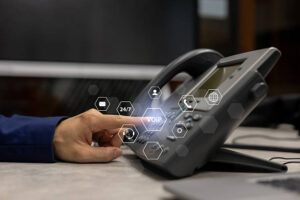
When most business owners think about cybersecurity, they think about their computers, their emails, passwords, cloud storage, or Wi-Fi network. Rarely does anyone stop to think about their phone system. I mean, what harm could come to your business through a phone, right? Well, wrong!
Your phone is as much a device as your computer, only smaller, and it can be an entry point for hackers through several technologies it supports. One of those technologies is VoIP, which stands for Voice over Internet Protocol.
So, what exactly is VoIP? Simply put, VoIP is a technology that allows you to make and receive phone calls using an internet connection instead of a traditional telephone line. Rather than your voice travelling through a dedicated phone network, VoIP converts your voice into digital data and sends it over the internet, just like your emails, video calls, and other online information.
This is why many businesses use VoIP today. You can make calls from computers, smartphones, desk phones, or other internet-connected devices, often with features such as call forwarding, voicemail, video conferencing, and automated attendants all built into the same system.
However, while VoIP saves you from some of the limitations of traditional phone systems, it also introduces a different set of security concerns. Because your business calls are travelling through an internet-connected system, your phone system can potentially become another entry point for hackers if it is not properly secured.
This article is aimed at educating you on how to properly protect your phone system from being an entry point to cybercriminals so let’s go!
What Makes VoIP Different From a Regular Phone Line?
In case you are still confused on why a VoIP makes you more vulnerable to hackers than a regular phone line, this is for you.
A traditional phone call travels over a dedicated physical line, which means it is a closed circuit, which makes it difficult, though not impossible, to intercept. VoIP works differently. When you make a call over a VoIP system, your voice is converted into packets of data and sent across the internet, just like an email or a file transfer; it reaches the other person, gets converted back into sound, and the conversation happens. From your perspective, it feels exactly like a phone call, but underneath, it is internet traffic and internet traffic can be intercepted, manipulated, and exploited if it is not properly secured.
That does not make VoIP a bad choice; not at all. The flexibility, cost savings, and features that come with a well-managed VoIP system genuinely make it one of the best communication tools available to small businesses today, but like any tool that connects to the internet, it needs to be set up and maintained with security in mind.
The Risks Associated with VoIP that Most Businesses Are Not Aware Of
- Eavesdropping: A co-founder of a notetaker tool once made a post about how in the early days of their business, they used to join the meetings of their users, manually take the notes and send a summary before they grew to the point where they could build a proper AI system. You might think the users knew they had uninvited members in their meetings, however they did not. They all innocently thought it was an AI tool automatically taking notes.
Now, VoIP grants hackers the possibility of eavesdropping on your calls if they manage to intercept the traffic. If they’re able to do that, they get to listen to your business calls, get access to financial details, contract terms etc that they could wield against your business to cripple it.
Thankfully, a system exists to prevent this from happening and it is known as encryption. Encryption is the process of scrambling data so it can only be read by the intended recipient. A VoIP can be configured or set up for encryption, which means no one gets to interpret the data transmitting over the internet connection, except the intended person (people).
- Toll Fraud: This is one of the most financially damaging VoIP risks and one of the least talked about. Toll fraud happens when an attacker gains unauthorized access to your VoIP system and uses it to make calls, typically international calls to premium-rate numbers at your expense! Do you know what that means? It means a hacker can use your VoIp system to make calls which you end up paying for.
Knowing that these calls can be made at scale, in a very short window of time, the charges can be enormous before anyone notices something is wrong. One rogue user exploiting a poorly secured system can cause thousands of dollars in losses in just a few hours; most businesses discover it when a phone bill arrives that makes no sense. By then, the damage is already done.
- Vishing and Caller ID Spoofing: You have probably heard of phishing, which is fraudulent emails designed to trick people into giving up sensitive information. Vishing is the same concept applied to phone calls, and it is a growing problem. Voice phishing attacks increased by 442% in 2024, fueled by AI-powered technology that makes it easier to mimic real voices.
AI powered technology can make a hacker manipulate the caller ID displayed on your screen which can make a call appear from a trusted number like your bank or loved one. They can then go ahead to manipulate the voices of these persons and trick either you or an employee into giving up sensitive business information.
- Account Takeover: Just like your email or your cloud accounts, VoIP systems have login credentials. If those credentials are weak, reused, or unprotected, an attacker who obtains them can take over the account entirely, redirecting calls, accessing voicemails, changing settings, or using the system to launch further attacks. The same principles we have covered in previous posts on password hygiene and multi-factor authentication apply here just as much as anywhere else in your business.
What Makes a VoIP System Vulnerable?
Now that we have looked at the various ways an unsecured VoIP system can bring trouble to your business, it is important to understand what can make a VoIP system vulnerable to these attacks.
First, it is important to understand that VoIP itself is not the problem; the problem often comes from how the system was set up and, more importantly, how it has been managed since it was installed.
A VoIP system can become an easy target when basic security measures are overlooked. For example:
- Default passwords are never changed: Leaving the usernames and passwords that came with the system in place gives attackers an easy starting point.
- Admin interfaces are exposed to the internet: If administrative controls are accessible online without proper restrictions, attackers may have an opportunity to try to gain access to the system.
- Software and firmware are not regularly updated: Updates often fix known security weaknesses. When a system goes months without being updated, those weaknesses can remain entry points.
- Call logs are not monitored: Unusual calling patterns, unexpected international calls, or sudden spikes in call activity can be early signs that something is wrong. Without monitoring though, these warning signs can easily be missed.
- International calls are not properly restricted. If your business does not need to make calls to certain countries, there is no reason to leave those destinations accessible through your phone. Restricting international calling to only the countries your business actually needs can help prevent compromise of your phone system, and even limit the damage that can be done if a compromise indeed happens.
- Premium-rate numbers are not blocked. Fraudsters can exploit compromised VoIP accounts by making large numbers of calls to expensive premium-rate or special-service numbers. Blocking these numbers can help prevent unauthorized calls and charges to your account.
- Guest Wi-Fi shares the same network as the VoIP system: If guests or visitors can connect to the same network used by your phones, it could create another potential path into the system.
These gaps may seem very simple and hard to miss; however, they often go unnoticed in an unmonitored environment and give cybercriminals an easy way to hack into a system.
What a Secure VoIP Setup Actually Looks Like
Securing a business VoIP system simply entails closing whatever gaps exist in your system, and making your call system risk free as much as possible. These ways could include:
- Encryption on every call: Both the call setup and the voice data itself should be encrypted. This prevents the data being understood by other parties apart from the intended persons.
- Strong credentials and MFA on all accounts: VoIP admin accounts are high-value targets. Ensure your system set-up has strong, unique passwords and multi-factor authentication enabled.
- Network segmentation. Your VoIP traffic should be separated from your general business network and, critically, from any guest Wi-Fi you offer. When everything shares the same network, a security problem anywhere becomes a potential problem everywhere.
- Call monitoring and anomaly alerts. Unusual calling patterns, especially, international calls at odd hours, a sudden spike in call volume, calls to numbers that do not match normal business activity are often the first visible sign of toll fraud. Monitoring call logs proactively rather than reviewing them after the bill arrives is one way of detecting when a hacker has accessed your system.
- Regular updates. VoIP system software needs to be kept current. Updates to these softwares are often designed to fix known security issues that have been identified by the developers so an outdated system is easy for a hacker to get into.
- Working with a provider who manages security as part of the service. A VoIP system should not be something that gets installed and then forgotten. It is important to work with an IT partner like Stonepoint technologies to help you manage and protect your system from vulnerabilities.
It is easy to think of cybersecurity as something that has to do with your emails and computer setup; however, your phone system is just as important and as a business owner who is concerned about confidentiality of clients information, your VoIP system should not be left out of your security setup.
StonePoint Technology Partners build and manage VoIP systems for dozens of businesses, providing proper encryption and network configuration for effective monitoring and support.
We would definitely be happy to review your current phone setup, and ensure it’s as secure as it should be to prevent unwanted visitors. If you are also thinking of setting up a VoIP for your business, then let’s talk immediately and give you the maximum protection your business needs.
Send us an email at Info@stonepointtech.com or call us at (727) 478-7355. We are here to help.